9.2 Lifestyle Chemistry: Drugs in the Digestive System

Practical

Aim:
To determine the effect of acidity on the neutralisation of antacid tablets

Hypothesis:

Independent variable:

Dependent variable:

Constant variables:

Equipment:
1 x measuring cylinder
2 x 150 mL beaker
2 x stopwatch
2 x antacid tablets
pH paper and key
10mL 1M Hydrochloric acid (HCl)
10mL Vinegar (Acetic acid)
100mL tap water

Risk management:

Method:
  1. Dilute the hydrochloric acid in 50mL of water
  2. …
  3. Table:
  4. Graph:

Administration of drugs

•       There are many ways that drugs can be administered:
–      By mouth
–      By inhalation (very fast absorption into nasal membranes)
–      Skin or dermal patches (slow absorption)
–      Creams
–      Suppositories by rectum or vagina
–      Injection into blood or tissue
–      Ear or eye drops onto affected tissue

Water-soluble v Fat-soluble

Water-soluble
Fat-soluble
Vitamins A, D, E, K
Can be stored in body tissue
Can be toxic if too much is taken
B1, B2, Niacin, B6, pantothenic acid, biotin, B12, folate, vitamin C
Excess amounts will be excreted in urine

Review of Objectives

•       Explain why a knowledge of the solubility of materials can be used to design drugs for specific tasks
•       Account for the absorption of a drug and its action on/in the body in terms of its solubility
•       Identify that the manner of administration of a drug may be related to its solubility
•       Identify vitamins that are water soluble and those that are fat-soluble

9.2 Lifestyle Chemistry: Human Digestive System

Objectives

•       Identify the parts of the digestive system
•       Outline the role of the stomach and the small intestine in breaking down food
•       Discuss the difference in pH of the stomach and the small intestine

Role of the stomach

•       Storage of food
•       Conversion of food by gastric juice into a soft semi-fluid mass which is released into the duodenum for transfer to the small intestine
•       Protein digestion.  Gastric juice contains enzymes which start breaking down proteins.  Hydrochloric acid keeps the stomach at the best pH for these enzymes.
•       Not much food is absorbed into the body in the stomach
•       A small amount of water is absorbed
•       Some fat-soluble substances are absorbed

Role of the small intestine

•       Completing the breakdown of food using:
–      Digestive juices from the pancreas
–      Bile form the liver (emulsify fats)
–      Enzymes from the wall of the intestine (proteins converted to amino acids)
–      Carbohydrates converted to glucose
•       Most water is digested in the duodenum and small intestine

pH in the digestive system

•       HCl makes the stomach much more acidic than the small intestine
•       Pancreatic juice is alkaline.  This neutralises the HCl and generates the ideal pH for the enzymes in the small intestine

Review of Objectives

•       Identify the parts of the digestive system
•       Outline the role of the stomach and the small intestine in breaking down food
•       Discuss the difference in pH of the stomach and the small intestine


9.2 Lifestyle Chemistry: Solvents

Objectives

•       Identify water and alcohol as commonly used solvents
•       Explain the relationship between the properties of solvents and their use in cosmetics and external medications
•       Identify cosmetics and external medications where water is the solvent
•       Identify cosmetics and external medications where alcohol is the solvent

Solvents

•       All products that are solutions contain a solvent that dissolves important components into the product.
•       Water is the most common, but there are many other solvents like Ethanol, turpentine, kerosene and isopropyl alcohol.  These other solvents are organic solvents.

Organic solvents

•       In broader society, “organic” usually means a non-harmful part of nature with a little human interference as possible
•       The scientific definition of “organic” means a substance that contain carbon-based compounds
•       Organic solvents are ALWAYS harmful

Types of solvent

•       Water is used in substances that need to flow well (low viscosity)
–      Hair gel, moisturiser
•       Alcohol evaporates quickly and leaves the substance behind on the skin
–      Deep heat, nail polish, nail polish remover

Dissolution rates

•       Plan and conduct an investigation to compare the rates that capsules, tablets and enteric coated tablets dissolve.
•       What variables will we need to control?

Review

•       Identify water and alcohol as commonly used solvents
•       Explain the relationship between the properties of solvents and their use in cosmetics and external medications
•       Identify cosmetics and external medications where water is the solvent
•       Identify cosmetics and external medications where alcohol is the solvent

Homework

•       Use a variety of resources to research about subdermal implants.  Use your research to prepare a 2 minute presentation.
•       Your presentation needs to describe one particular type of subdermal implant.  In particular:
–      How does it work?
–      What is it used for?
–      What problems can occur?
•       It is advisable to use visual aides,
•       This is not a formal assessment task but you will be marked by your classmates. 


9.2 Lifestyle Chemistry: Skin and Microflora

Revision

  1. State one example of oil-in-water and one example of water-in-oil emulsions
  2. Describe four different types of emulsions
  3. Explain why cleaning agents must be surfactants

Objectives

•       identify the role of the skin as
                – an organ to separate the body from the  external environment
                – an organ assisting in body temperature control
                – an organ to protect against entry by    disease-causing organisms
•       define the term ‘microflora’ and discuss the role of the microflora on skin in different parts of the body
•       discuss the term pH in terms of its ability to describe the acidity of a substance
•       explain the relationship between the natural pH of the skin and the action of
                – microflora
                – natural oil produced by glands in the skin
                – perspiration
•       identify and explain the use of common components of body soaps, cleansers and shampoos and the reason for their use

The skin

•       The skin performs a number of roles
–      Protects from the outside environment, especially dangerous organisms
–      Allows enough sunlight through for vitamin D but not enough to do damage (ideally)
–      Sense temperature and pressure changes
–      Temperature control
–      Excretes water, urea and minerals (sweat)

•       The skin is made up of two layers, the epidermis (outer layer) and the dermis (inner layer).  Below that is the hyperdermis.


•       Describe the process by which skin increases the body’s temperature
•       Describe the process by which the skin decreases the body’s temperature
•       Practical investigation:
•       Using a microscope/bioviewer to view skin samples
•       Draw what you observe

Microflora

•       Microflora refers to the full range of microorganisms and they live, amongst other places, on your skin and in your body.
•       The skin is a barrier to most microflora because it is:
–      Too acidic
–      Too cold
–      Too salty
–      Exposed to UV radiation
–      Too dry (in parts)
•       Microflora make it harder for pathogens to survive on the skin.  They take up space and consume food.

Types of Microflora

•       Bacteria:
–      Cocci (skin surface, usually harmless)
–      Diptheroids (follicles, can cause pimples)
•       Yeast (fungi):
–      Pityrosporum ovale  (eats fat, can cause dandruff)
–      Malassezia furfur (chest and back)
–      Candida albicans (can cause thrush)
–      Trichospora beigelii (scalp)
•       Mites:
–      Democlex folliculorum (hair follicles, harmless)

Components of body soaps, cleansers and shampoos

•       Soap
–      Fatty acids or sodium
•       Cleansers
–      Surfactants, humectants, perfumes, preservatives, antioxidants, acidifying agents, bactericides
•       Shampoo
–      Detergent, surfactants, pH balances, germicides, perfumes, colouring agents

Review questions

  1. State the function of human skin
  2. Describe the different parts of human skin
  3. Explain why cosmetics should be pH neutral.
  4. Explain why cosmetics could not be perfectly pH neutral


9.2 Lifestyle Chemistry: Surfactant and Colloid Cleaning Products

Properties of emulsions

•      Emulsions allow oily substances and water to be applied to a surface at the same time
•      The two phases (oil and water) are mixed together using an emulsifier.
•      Emulsifiers are described using a 1-20 scale called the hydrophilic-lipophilic balance (HLB)
•      The lower the HLB, the more less water in the resulting emulsion

Properties of emulsions:


•      Purpose of emulsions Surfactants can emulsify grease into water and can also make water more alkaline which can neutralise acids.

First hand investigations

•      Write experiments to compare different emulsions based on:
a)     Feeling
b)    pH
c)     Conductivity

First hand investigation

Aim: To determine the effect of surfactants on water drops
Equipment:
2 x pipette droppers
2 x measuring cylinder
500mL dishwashing liquid
2L tap water
2 x 250mL beakers

Method:
1.     Pour about 200mL of water into one beaker
2.     In the other beaker, mix 200mL water with 20mL of dishwashing liquid (the exact amounts are not important at this stage)
3.     Using one pipette, put 200 drops of tap water in one measuring cylinder.  Record the volume.
4.     Using the other pipette, put 200 drops of the detergent mixture in the other measuring cylinder.  Record the volume.
5.     Repeat steps 3 – 4 five times and average results.

Results


Discussion

What trend was observe?
Explain this trend.

Conclusion

Did you answer the aim?
What is the trend of your results?


9.2 Lifestyle Chemistry: Mixtures and Solutions


Important terms:

•Solute = A solid that dissolves into a solution
•Solvent = the substance in which a solute dissolves
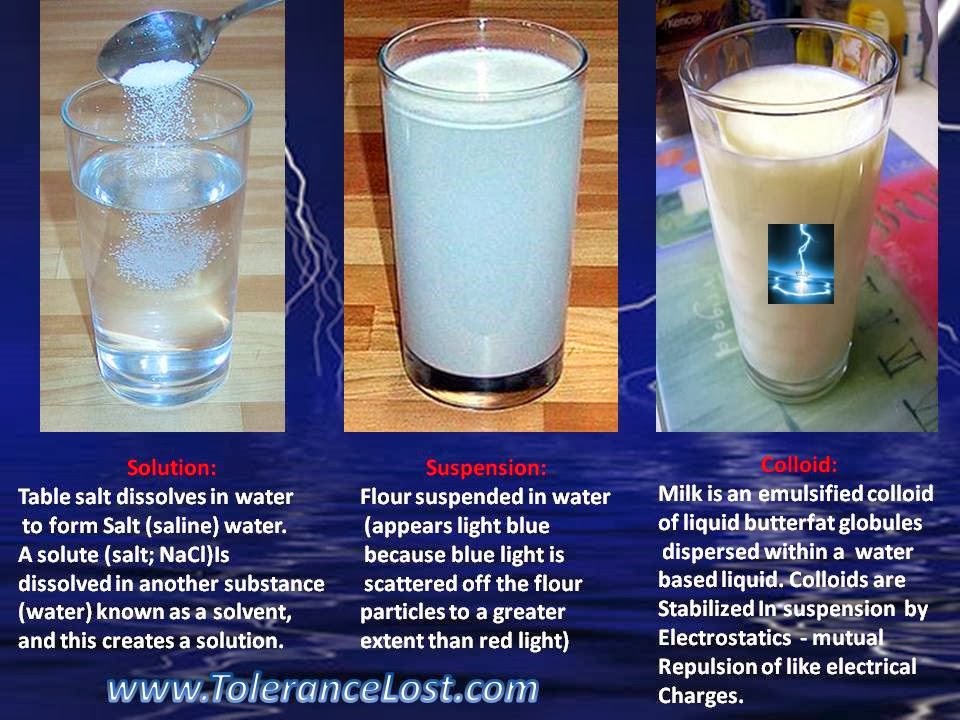
•Solution = contains dissolved substances that are uniform throughout, is transparent and may be coloured; the solute is dissolved entirely in the solvent
•Mixture =  two or more substances not chemically combined
•Colloid = mixtures where large molecules or small clusters of molecules are dispersed through the liquid and do not settle out
•Homogenous = Evenly distributed
•Heterogeneous = Unevenly distributed

Types of mixtures:

•Suspension = insoluble solids suspended in liquids; the solids eventually settle upon standing
•Colloid = mixtures where large molecules or small clusters of molecules are dispersed through the liquid and do not settle out
•Emulsion = dispersion of a liquid in another liquid in which it is immiscible
•Solutions appear clear, leave no residue when filtered and a light beam cannot be seen in the solution.
•Suspensions contain insoluble solids that will eventually settle, forming layers upon standing. Residue is left when filtered and a beam of light can be seen in the suspension.
•Colloids are mixtures of large molecules or small clusters of molecules dispersed in a liquid. Colloids are not clear, a beam of light can be seen in the colloid, and no residue is left after filtering.

Examples of colloids:

•Solid-in-liquid such as water-based paint, ink, jelly, toothpaste
•Gas-in-liquid foams such as mousse, whipped cream
•Liquid-in-liquid emulsions such as oil-in-water or water-in-oil.


Questions:

•Compare a solution to a colloid
•Explain why water is important in the human body
•Describe an advantage of a highly stable colloid